
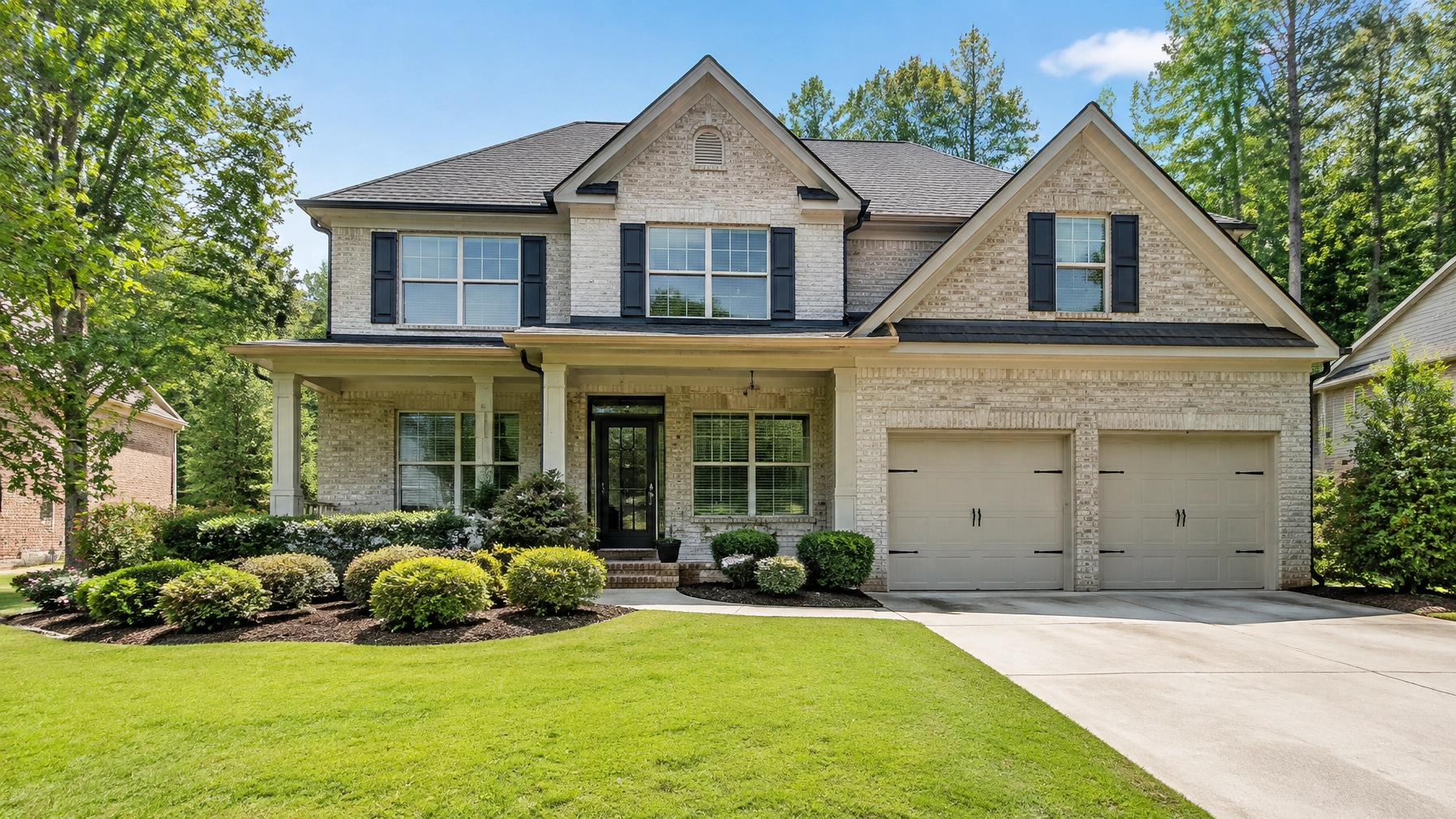
Mortgage Rate Update: Where Rates Sit Now and What It Means for Your Move
Written by Tamera Shearon, Broker, Owner, and Mortgage Loan Originator: NMLS #2413707, GA #366882
September 2026 Mortgage Rate Update
Are you hearing “7% mortgage rates” and wondering whether your move just hit a giant Atlanta pothole?
Before you panic, take a breath.
The Winter 2026 Selling Guide offers an important piece of perspective: the worst of any major home-price declines is behind us. Home values have flattened into slow, stable normalization rather than falling off a cliff. National values are projected to finish the year up roughly 1% to 1.4%.
Homeowners are also sitting on substantial equity. The average homeowner has about $270,000 in equity, nearly $90,000 more than at the start of the pandemic. And approximately 67.7% of Americans either own their home free and clear or have at least 50% equity.
That matters.
A mortgage rate is one part of your move. Your equity, income, timeline, goals, and the specific Atlanta property you want are part of the larger picture.
Here is this month’s mortgage rate update, and what it may mean for you.

Where mortgage rates sit right now
As of September 17–20, 2026, the major benchmarks are clustering around the high-6% to low-7% range.
- Freddie Mac PMMS 30-year fixed: 6.95% for the week ending September 17
- Optimal Blue 30-year conforming note rate: 7.01% on September 17
- Optimal Blue 15-year conforming note rate: 6.40%
- Bankrate 5/1 ARM national average APR: 6.75% on September 19
The Optimal Blue 30-year conforming rate was up 13 basis points from September 10 and up 31 basis points over the previous 30 days. Its 52-week range was approximately 5.90% to 7.05%.
The near-term working range for the 30-year benchmark is roughly 6.95% to 7.15%, with a slight upward bias.
That is not a prediction carved in stone. It is a planning range.
These figures are benchmarks, not personal quotes, guarantees, or locked offers. Your live lender quote, with matched points, fees, credit profile, loan type, down payment, and lock period, is the number that matters.
Why rates are moving this month
The Federal Reserve raised the federal funds target range by 25 basis points on September 16, bringing it to 3.75%–4.00%. September projections placed the median year-end federal funds rate at 4.1%.
But here is a common myth:
The Fed does not directly set your 30-year mortgage rate.
Mortgage rates respond more directly to bond-market conditions, inflation expectations, investor demand, and the 10-year Treasury. The 10-year Treasury closed at 5.01% on Friday, September 18, helping keep upward pressure on mortgage pricing.
The economic data is mixed, more “Atlanta traffic on I-285” than smooth sailing:
- August retail sales increased 1.2%
- Initial jobless claims were relatively low at 196,000
- Housing starts fell 2.6%
- Industrial production was unchanged
Strong consumer activity and a resilient labor market can make investors expect interest rates to stay higher for longer. At the same time, softer housing activity suggests the market is not running hot everywhere.
That tension is why rates can move quickly.
What the current rates mean for Atlanta buyers
A 7% mortgage rate may not be your favorite guest at the closing table. But it does not automatically mean you should cancel your move.
The better question is:
Does the payment work for your budget and your life?
For example, on a $400,000 loan:
- At 7.01%, principal and interest are approximately $2,664 per month
- At 7.15%, principal and interest are approximately $2,702 per month
That is a difference of roughly $38 per month.
Taxes, homeowners insurance, mortgage insurance, and HOA dues are not included. Still, the example shows why a small rate move does not always change the entire strategy.
You may also have options beyond a standard 30-year conventional loan. Depending on eligibility and the property, you might compare:
- FHA loan options
- VA financing
- USDA financing for eligible rural properties
- Conventional financing
- Jumbo financing
- Construction or renovation financing
- Refinance strategies as market conditions change
A lower rate is not automatically a better loan. A shorter term, a temporary buydown, seller concessions, or a different loan program may be worth comparing.
15-year versus 30-year: lower total interest or lower monthly payment?
The 15-year fixed rate is about 62 basis points below the 30-year benchmark. But the monthly payment is significantly higher.
On a $350,000 loan:
| Loan option | Approximate principal and interest | Approximate total interest over full term |
|---|---|---|
| 30-year fixed at about 7.01% | $2,331 per month | $489,100 |
| 15-year fixed at about 6.40% | $3,030 per month | $195,300 |
The 15-year option could save approximately $293,800 in total interest over the full loan term, but it requires nearly $700 more per month.
That is the tradeoff.
The right mortgage is not the one with the lowest rate on a spreadsheet. It is the one that supports your actual financial breathing room.
Understanding APR
The interest rate tells you the cost of borrowing the principal. APR, or annual percentage rate, goes further by incorporating the interest rate plus certain lender fees and points.
That makes APR a better apples-to-apples comparison tool when you are reviewing offers.
Here is the catch: a loan with a lower advertised rate may require substantial points or fees. In that case, it can carry a higher APR than a loan with a slightly higher rate and lower upfront costs.
Illustrative benchmark comparison
| Loan type | Benchmark rate | APR information | Methodology note |
|---|---|---|---|
| 30-year fixed | 6.95% Freddie Mac PMMS; 7.01% Optimal Blue note rate | APR not reported in the supplied benchmark data | Freddie Mac is a weekly national survey; Optimal Blue reflects a conforming note-rate benchmark |
| 15-year fixed | 6.40% Optimal Blue note rate | APR not reported in the supplied benchmark data | Shorter-term conforming note-rate benchmark; actual APR depends on fees and points |
| 5/1 ARM | 6.75% national average APR | 6.75% APR | Bankrate national average APR; ARM terms, caps, margins, and methodology differ from fixed-rate benchmarks |
These are illustrative market benchmarks, not quotes or guarantees. When comparing lenders, request same-day Loan Estimates or quotes with identical loan amounts, points, lender fees, credits, lock periods, and program terms.
Should you lock or float?
There is no universal answer. Your closing timeline and tolerance for change matter.
A practical framework:
- Closing within 30–45 days: Lock if the payment works for your budget and the terms are acceptable.
- More than 60 days away: Floating may be defensible if your budget can absorb a move into the low 7.10s.
- Comparing lenders: Get at least three same-day quotes with identical points, fees, and lock periods.
- Already locked: Ask whether a float-down option is available if rates improve before closing.
Do not compare one lender’s “headline rate” against another lender’s rate with different points and fees. That is like comparing a lemon to a peach and wondering why the fruit salad tastes confusing.
The lowest rate is not always the lowest-cost loan.
What this means for Atlanta sellers and refinancers
If you are considering whether to sell your house in Atlanta, today’s rates may affect your buyer pool, but they do not erase buyer demand.
The Winter 2026 Selling Guide notes that buyers have more choices, sellers need realistic pricing, and well-maintained homes with strong curb appeal can still stand out. Inventory is growing, but that is not the same thing as a market freefall.
For sellers, the strategy is clear:
- Price from current, hyper-local comparable sales.
- Highlight condition and improvements.
- Consider whether closing-cost assistance or a temporary rate buydown could attract more buyers.
- Use your existing equity to plan the next purchase.
For homeowners considering a refinance, start with the goal:
- Lower the monthly payment
- Change the loan term
- Remove mortgage insurance, if eligible
- Consolidate certain debts
- Access funds for renovations
- Move from an adjustable-rate loan to a fixed-rate loan
Refinancing is not automatically beneficial simply because rates move lower. Closing costs, the break-even period, your remaining loan term, and your plans for the home all matter. Explore Peachtree Battle Realty’s mortgage and refinancing services and review the broader mortgage resources before making a decision.
The calm takeaway
The headlines may make 7% sound like a four-alarm fire.
It is not.
It is a market condition to evaluate carefully.
Home values are stabilizing. Equity remains a major homeowner advantage. Rates are elevated but navigable. And the best move depends on your complete situation, not one percentage printed in a headline.
For buyers looking at residential properties in Atlanta, the power move is preparation. Know your payment range. Compare programs. Understand APR. Get a same-day quote. Then decide from facts instead of fear.

Read the full Winter 2026 Selling Guide
This monthly mortgage rate update is only one slice of the market picture.
For the larger conversation about home values, equity, inventory, pricing strategy, seasonal selling, and preparing your property, read the full Winter 2026 Selling Guide.
Then, when you are ready, contact Tamera Shearon for a same-day pre-approval conversation:
- Email: tamera@peachtreebattlerealty.com
- Phone: 678.251.5024
- Website: peachtreebattlerealty.com
- Availability: 24/7
- Service promise: Same-day call returns, or we provide a $100 commission discount

Love Your Neighbor: Real Estate with a Purpose
Every move is personal.
It may mean a first home, a better commute, room for a growing family, a place to age comfortably, or the chance to sell a property and begin a new chapter.
At Peachtree Battle Realty, we believe real estate should strengthen more than a balance sheet. Through our Love Your Neighbor mission, we work to support community, local growers, food resilience, and the future of Green Olive Tree Farm.
When you can, grow something of your own or support a local farmer. Protect seed diversity. Choose produce that can reproduce rather than always purchasing seedless varieties. Small decisions can help keep local food systems resilient.
That is our neighbor-to-neighbor approach: educate honestly, serve diligently, and help you make your winning move.
Equal Housing Lender | NMLS #2413707 | NEXA Mortgage NMLS #1660690 | Georgia License 366882. OTC construction loans subject to eligibility and builder approval requirements. Not all applicants will qualify. Programs subject to change.
#savethefarms #savethefarmers